Crown Reduction & Thinning
A tree that has grown too big or too heavy does not always have to go. We bring it back to a sensible size and keep its natural shape. Working across Warrington and the towns around it.
Get a Free QuoteSmaller, without looking butchered
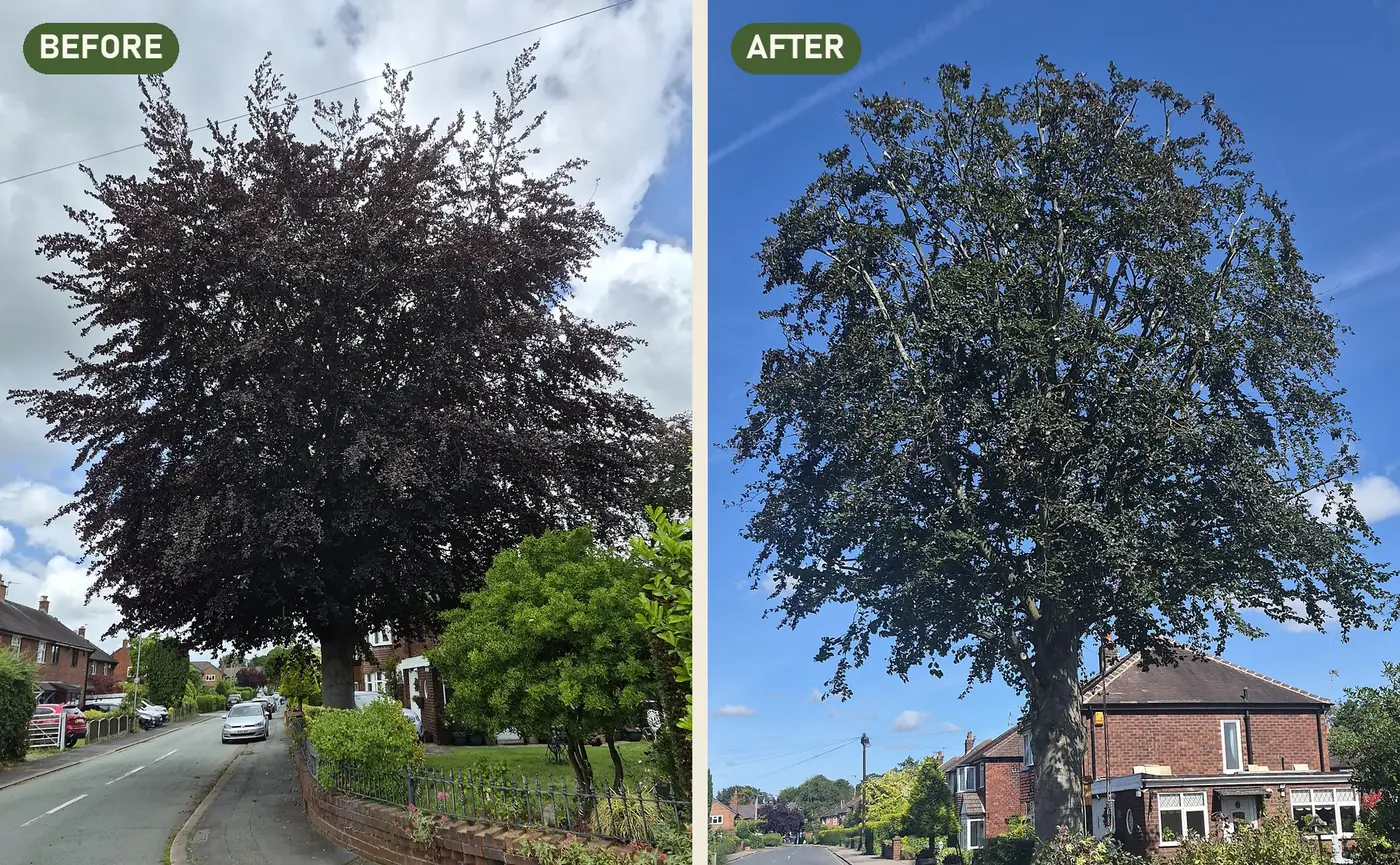
A good reduction is hard to spot afterwards. The tree is usually one to three metres smaller around the crown, depending on the species and how it has grown, yet the outline is still its own. That comes from cutting back to a suitable side branch every time, so a living shoot carries on from each cut.
People usually call us when branches have reached the roof or gutters, when the garden has gone dark, or when an old tree is carrying a lot of weight at the ends of its limbs.
Three jobs that get mixed up
Reduction makes the crown smaller all round. Thinning keeps the size but opens up the inside, so the tree catches less wind and lets more daylight through. Lifting clears the low branches and gives you headroom.
You are not limited to one. A sycamore shading the kitchen might want a light reduction on the house side and a lift above the patio. Combining two small jobs often beats one heavy one.
Please do not let anyone top your tree
Topping means sawing straight across the upper limbs and leaving stubs. It looks like a bargain at first. The tree then responds with a mass of fast, weakly attached shoots around each wound, and those can break out in high wind a few years later.
The big open cuts also let decay into the main stems. So you pay once for the topping, then again to deal with what grows back. If a quote mentions topping, ask for a reduction instead.
When to book it
Most broadleaved trees are best reduced while dormant, from late autumn to early spring. With no leaves in the way we can read the branch structure clearly, and the tree starts sealing its cuts when growth returns in spring.
Some species differ. Cherries and plums are better done in summer, because of the risk of silver leaf disease. Birch, maple and walnut bleed heavily in late winter, so we leave them until they are in leaf. Nesting birds are protected too, and we check for them before cutting between March and August.
What your quote covers
- A free visit and a written price
- Public liability insurance
- Reduction, thinning and lifting
- Deadwood and crossing branches removed
- Work to BS3998 good practice
- A check for TPOs and conservation areas
- Brash chipped and taken away
- Logs left for you if you want them
Pruning a protected tree
This catches people out: the rules cover pruning, not only felling. A tree with a Tree Preservation Order needs written consent from your council before a reduction, and a tree in a conservation area needs six weeks' notice.
We check which applies when we visit and can help word the application, so that what the council approves matches the work you actually want done.
Questions people ask
Ring 07943 961691 or fill in the form below. The quote is free and there is no pressure to go ahead.
Ready when you are
Get a free, no-obligation quote. Most enquiries get an answer within 24 hours.
Prefer to talk it through? Give us a call:
📞 07943 961691Thanks, that's on its way!
We'll be in touch within 24 hours, and may ask you to text a photo or two of the job. If you would rather talk, call 07943 961691.